
关于
Pip-Boy Living Clock for FoloToy AI Passport
English | 简体中文
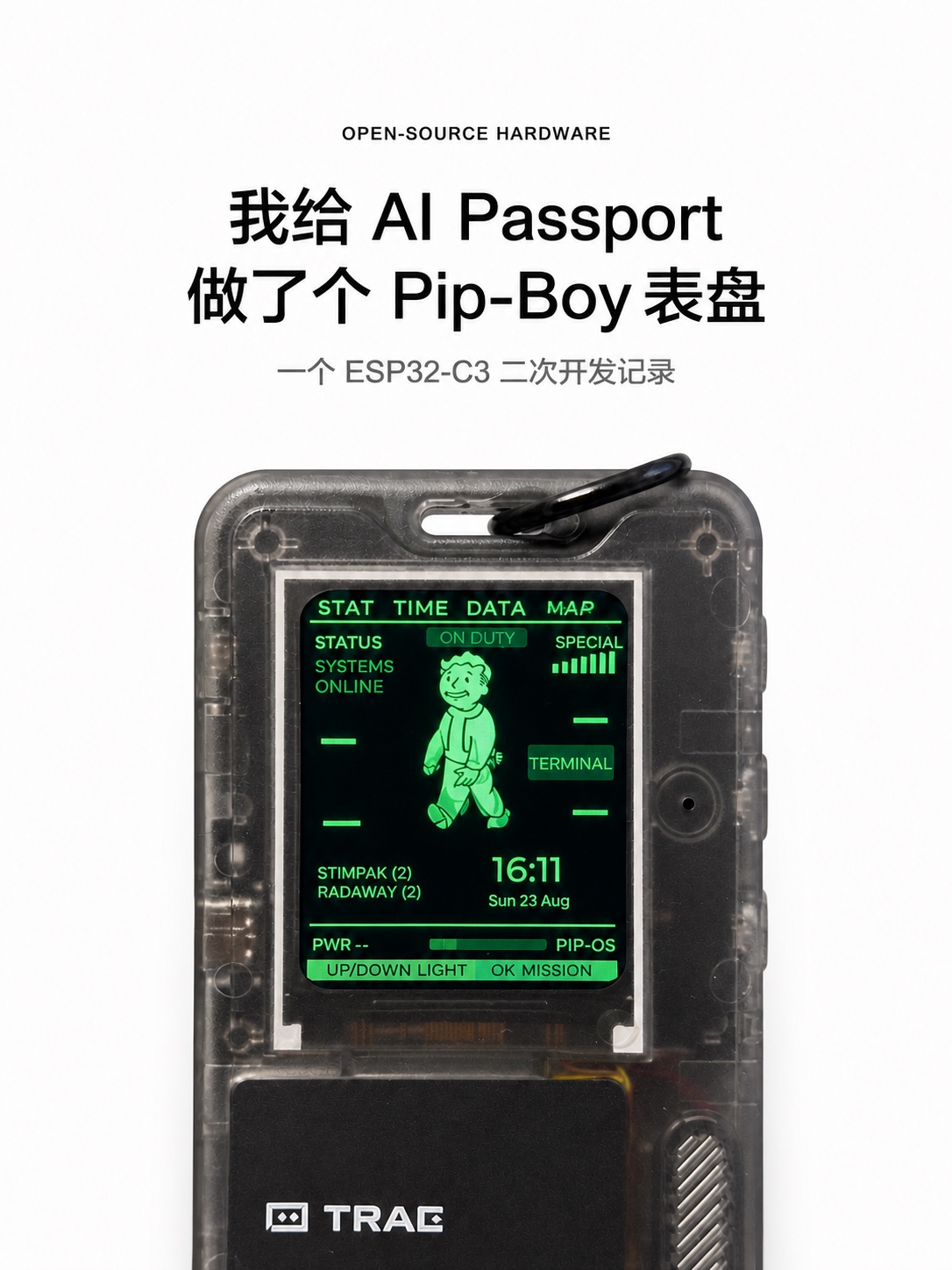
A fan-made, non-commercial, open-source firmware project that turns the FoloToy AI Passport into a lightweight Pip-Boy-style living clock and Mission Timer. It is an independent hardware modification, not an official FoloToy, Bethesda, or ZeniMax product.
The repository also serves as a development baseline for this ESP32-C3 device. It keeps the hardware facts, stable interfaces, resource boundaries, reference implementations, and validation methods that an agent needs to build new applications in one place.
Pip-Boy Living Clock v0.6.1
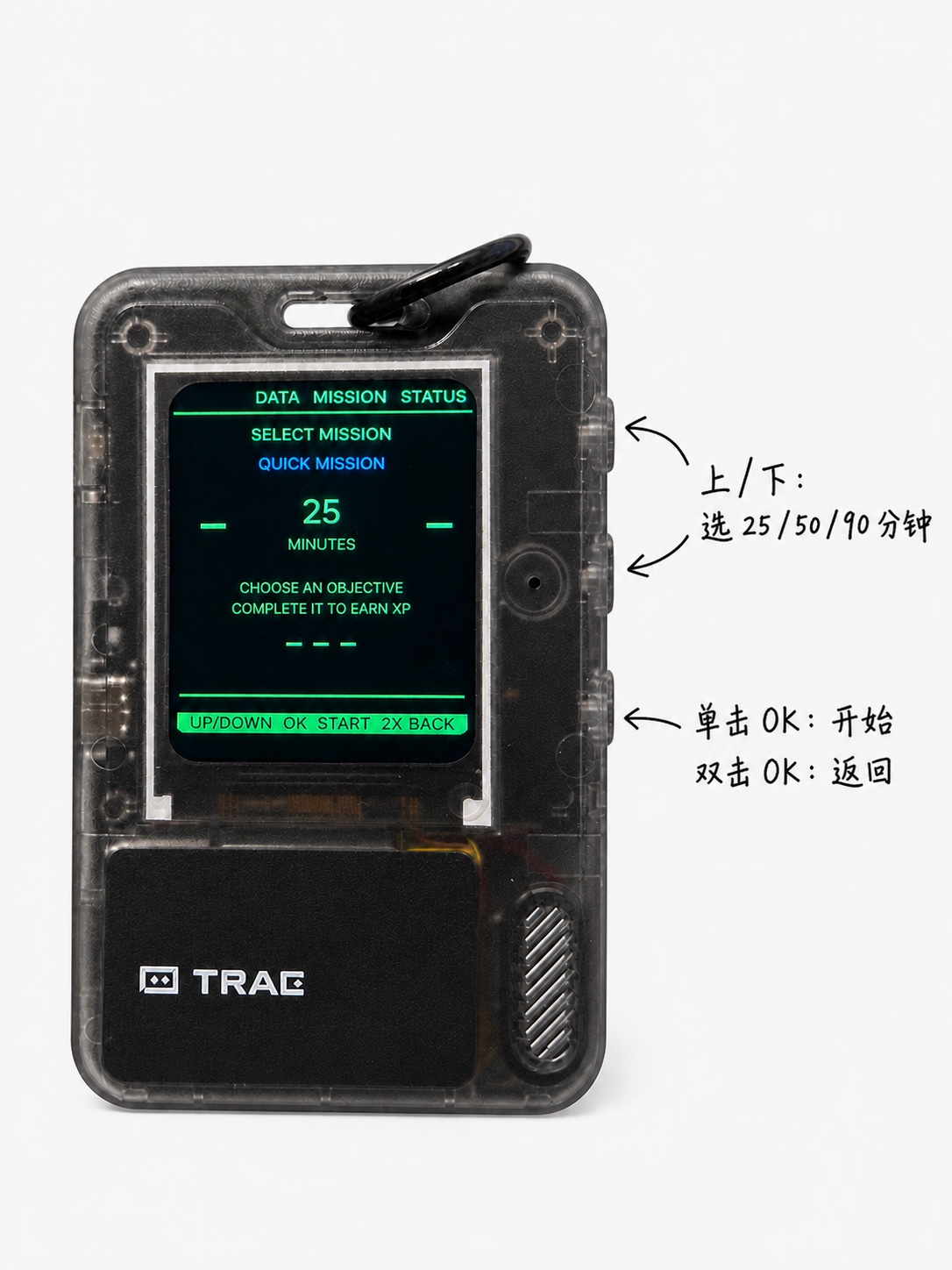
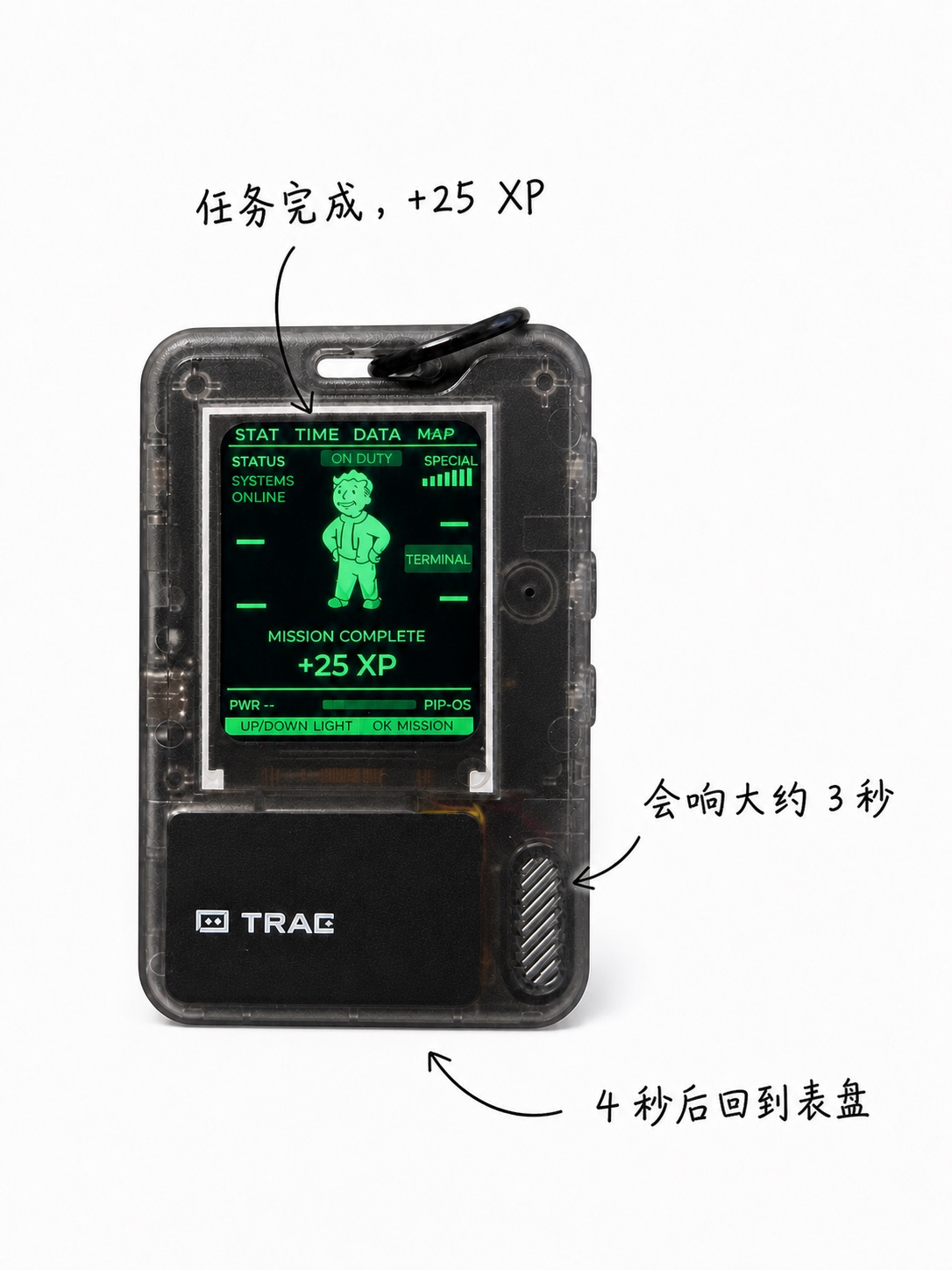
The current product build turns FoloToy AI Passport into a lightweight Pip-Boy-style desk clock. It features an eight-frame walking Vault Boy animation, 25 / 50 / 90-minute Mission Timers, USB clock sync, battery-readout fallback, a quest-complete cue, a cold-boot Power Up cue, and automatic screen-off after 20 seconds of inactivity.
- End users should start with the Chinese installation guide.
- The one-click browser installer and macOS fallback script live in
web-installer/. - See v0.6.1 release notes for controls, validation, and known limitations.
- See Third-party assets and attribution for the material sources and license boundary.
Important
This is a non-commercial fan project. The MIT license applies to project-authored code only. Fallout, Fallout Shelter, Vault Boy, Pip-Boy, and related visual/audio material belong to their respective rights holders and are not relicensed under MIT. See
THIRD_PARTY_ASSETS.md.
The repository is organized around the following principles:
mainis the smallest complete runnable baseline and an executable description of the current hardware capabilities.components/bspisolates board-level details and exposes stable APIs to applications.demo/*branches show different paths from a product requirement to a working implementation.AGENTS.mddefines how an agent should work in the repository, whiledocs/AI_HARDWARE_DEVELOPMENT_GUIDE.mdcontains the complete hardware context and troubleshooting knowledge.- Build results and physical-device results are reported separately. A successful build must never be presented as successful hardware validation.
The intended workflow is simple: give an agent this repository and an application requirement. The agent identifies the available capabilities and constraints, selects relevant examples, implements and builds the application, and returns an acceptance checklist that can be executed on the physical device.
Entry point for AI agents
Before starting development, establish context in this order:
- Read
AGENTS.md, this README, anddocs/AI_HARDWARE_DEVELOPMENT_GUIDE.md. - Run
git status --short --branchand preserve all existing user changes. - Read the affected
components/bsp/include/*.hheaders and their implementations. Do not infer board behavior from common chip or development-board configurations. - Use
git branch -r --list 'origin/demo/*'to find examples close to the requirement. Reuse only the relevant design patterns; do not merge an entire demo branch by default. - Break the requirement into inputs, outputs, state, concurrent tasks, persistence, memory budget, and failure degradation before deciding whether to change
mainor extendcomponents/bsp. - Complete the minimum build check and all applicable logic tests. Keep explicit on-device acceptance items for every conclusion that depends on the display, buttons, audio, battery, or timing.
Source-of-truth priority
When information conflicts, use this priority order:
Schematic / PCB / board revision / physical measurement
    > components/bsp/include/bsp_pins.h
    > BSP public headers and implementations
    > docs/AI_HARDWARE_DEVELOPMENT_GUIDE.md
    > README and example applications
The repository does not currently include schematic or PCB source files. When the board revision, wiring, polarity, register behavior, or unused GPIOs are unknown, an agent must report the unknown and request evidence instead of filling the gap with parameters from another ESP32-C3 board.
Hardware capability contract
The table below describes the application capabilities implemented by the current main branch. It is not a list of everything that might be possible according to the chip datasheet.
| Capability | Confirmed implementation | Application interface | Boundaries that must be respected |
|---|---|---|---|
| Display | ST7789P3, 240 × 320 portrait RGB565, SPI2 at 40 MHz; LEDC backlight | bsp_display_*, bsp_lvgl_* | The ESP32-C3 has no PSRAM; the current design uses a small single DMA buffer; no LCD MISO, touch, or known TE interface |
| Input | UP, DOWN, and OK share an ADC resistor ladder on GPIO0 | bsp_button_init(), bsp_button_read_mv() | Callbacks run in the button component task and must not block; do not create a second ADC1 unit |
| Audio | ES8311 with full-duplex PCM over I2S0, supporting playback and microphone capture | bsp_audio_* | PCM reads and writes block and belong in a worker task; format changes must retain the BSP close/open sequence |
| Battery | CW2017 state-of-charge and voltage readings | bsp_battery_* | This capability is optional at runtime; accuracy depends on the cell and battery profile and is not equivalent to a calibrated result |
| Shared bus | ES8311 and CW2017 share I2C0 | bsp_i2c_* | Every device must reuse the bus owned by the BSP; do not create another bus on the same port for scanning or a new device |
| Logging and flashing | Native ESP32-C3 USB Serial/JTAG | ESP-IDF console | GPIO18/19 are reserved for USB; the default UART0 TX on GPIO21 conflicts with the backlight |
All pins, addresses, panel parameters, and button voltage windows are defined only in components/bsp/include/bsp_pins.h. Application code must not duplicate these constants. See the AI Hardware Development Guide for the complete pin map, panel initialization, ADC thresholds, I2C addressing rules, audio clocks, and memory details.
Applications may also use ESP-IDF timers, FreeRTOS tasks, and internal Flash/NVS; the Pomodoro branch contains an NVS example. The ESP32-C3 supports 2.4 GHz Wi-Fi and Bluetooth LE, but the current BSP does not wrap either radio and main does not initialize a wireless stack. demo/claude-buddy-port is a BLE application architecture reference, not a substitute for measuring the current board's antenna, RF performance, power consumption, and coexistence behavior. Every FoloToy AI Passport has 8 MB of Flash, and the default firmware configuration targets 8 MB.
Capabilities outside the current contract
The repository does not currently provide enough evidence to guarantee touch input, display readback, an IMU, external storage, charging control, USB insertion detection, controllable power-amplifier enable, deep-sleep wakeup, arbitrary “free GPIOs,” exact battery capacity, or production-grade power specifications. A capability being present in the ESP32-C3 silicon does not mean that it is connected, powered correctly, or validated on this board.
Requirements involving these capabilities must begin with a schematic, board revision, component documentation, or physical measurements. Only then should the BSP and its acceptance criteria be extended.
Start development with one requirement
A simple request can be given directly to an agent:
On the main branch, build an offline habit-tracking application for FoloToy AI Passport.
Use the three physical buttons and the 240×320 display, and preserve records across power loss.
Follow AGENTS.md and AI_HARDWARE_DEVELOPMENT_GUIDE.md. Inspect relevant demo branches first,
keep hardware logic in components/bsp and application logic in main, deliver a runnable
implementation with tests, and report the build result, unexecuted device checks, and exact
on-device acceptance steps separately.
The more specific the requirement, the more likely the agent is to implement it correctly in one pass. Useful details include:
- User flow: what each page displays and what short press, double press, and long press do for each button.
- State and data: whether the application needs timing, persistence across power loss, networking, recording, or communication with a computer.
- Experience goals: fonts, colors, animation, sound, response time, and error states.
- Constraints: whether the main menu may be replaced, dependencies added, Flash used, or default interactions changed.
- Acceptance criteria: which behaviors require automated tests and which must be observed on real hardware.
When details are omitted, an agent may choose conservative defaults that do not change the product direction, but it must list those assumptions in the delivery. Decisions involving new wiring, electrical safety, board revisions, or irreversible data formats require confirmation first.
Demo branches are design cases, not a feature pile
Each demo/* branch evolves the baseline into an independent application. The branches demonstrate how specific problems were solved. New applications should normally branch from main and consult relevant examples instead of merging multiple demos wholesale.
| Branch | Application | Patterns worth reusing |
|---|---|---|
demo/stopwatch | Stopwatch | Minimal timer application, separation of pure logic from LVGL, host-side logic tests |
demo/cat-themed-pomodoro-timer | Cat-themed Pomodoro timer | Monotonic time, pause/resume, NVS persistence, a detailed PRD, and a state model |
demo/rock-paper-scissors | Rock paper scissors | RGB565 image assets, asset-generation scripts, and Flash resource tradeoffs |
demo/tetris-game | Three-button Tetris | Real-time game loop, low-latency PRESS input, partial refresh, a pure game model, audio, and microphone interaction |
demo/claude-buddy-port | Desktop AI hardware companion | Replacing the demo menu with a complete application, encrypted BLE, protocol parsing, state reduction, task communication, and extensive host tests |
Inspect an example without switching the current working tree:
git branch -r --list 'origin/demo/*'
git diff main...origin/demo/tetris-game -- main components tests
git show origin/demo/tetris-game:main/demo_tetris.c
Start a new application:
git switch main
git switch -c feature/my-passport-app
Example branches may change the same menu, configuration, or driver in incompatible ways. An agent must understand the differences before extracting a state model, asset pipeline, or concurrency pattern. Code appearing in an example branch is not automatically part of the current main BSP contract.
Application and BSP boundary
Natural-language requirement
  └─ main/                         Pages, state machines, animation, app tasks, assets
      └─ components/bsp/include/  Stable board-level APIs
          └─ components/bsp/src/  GPIO, buses, devices, and driver details
              └─ bsp_pins.h       Single source of truth for pins and hardware parameters
To add a regular page, create main/demo_<feature>.c and implement the enter, exit, and key interface, then update:
- Declarations in
main/demo.h. - The source list in
main/CMakeLists.txt. - The
DEMOS[]registration inmain/main.c. - Menu initialization status and failure degradation if a new optional peripheral is involved.
Only hardware capabilities shared by multiple applications belong in components/bsp. A BSP API must document blocking behavior, thread context, memory ownership, failure values, and initialization order. Pins and I2C addresses belong only in bsp_pins.h.
Runtime invariants
- LVGL is not thread-safe. Code outside the LVGL context must hold
bsp_lvgl_lock()while accessinglv_*objects. - Button callbacks only dispatch lightweight events. Recording, playback, storage, and other slow operations belong in worker tasks.
- When leaving a page, stop every task or timer that may access its UI before deleting the screen and clearing object pointers.
- The default global interaction is
UP/DOWNnavigation in the menu, shortOKto enter, and longOKto return from a page. Any change must be explicit. - New images, fonts, network stacks, audio buffers, LVGL buffers, and task stacks must be evaluated against internal RAM. Sufficient total free heap does not guarantee a sufficiently large contiguous block.
- Testable state machines, protocols, timing, and layout calculations should be separated from ESP-IDF/LVGL and covered by host-side logic tests.
Build and run baseline
The project uses ESP-IDF 5.5.x; the known development environment is 5.5.3:
get_idf553                    # Maintainer-local helper
# Or source "$HOME/esp/esp-idf-v5.5.3/export.sh" (example installation path)
idf.py set-target esp32c3     # Run for a fresh checkout or after using another target
idf.py build
idf.py flash monitor
The first build uses ESP-IDF Component Manager to fetch LVGL, esp_lvgl_port, button, esp_codec_dev, and other dependencies. Do not edit the generated managed_components/ directory. If configuration state is stale, use idf.py fullclean and configure again, but never use it to clean user source changes.
The current baseline includes a pure-logic test that can run independently:
cc -std=c11 -Wall -Wextra -Werror -Imain \
  tests/test_ui_pixel_math.c main/ui_pixel_math.c \
  -o /tmp/test_ui_pixel_math
/tmp/test_ui_pixel_math
Different example branches may provide their own host-test commands; follow the README on that branch.
Acceptance and delivery format
idf.py build is the minimum automated check, not hardware validation. For changes involving physical peripherals, record at least the following on a FoloToy AI Passport:
- USB Serial/JTAG produces stable startup logs with no reboot loop, assertion, or watchdog reset.
- Display orientation, colors, edges, refresh behavior, and backlight are correct.
UP,DOWN, andOKproduce the intended events, and longOKreturns correctly.- Audio sample rate, playback, non-zero recording, and page exit behavior are correct.
- Battery readings are plausible, and the application degrades safely when the CW2017 is absent.
- Repeated page transitions and concurrent operations do not continuously leak tasks, objects, or heap.
An agent's final delivery must distinguish these outcomes:
Build: PASS / FAIL / NOT RUN
Host tests: PASS / FAIL / NOT RUN
Device tests: PASS / FAIL / NOT RUN
Unverified: items that still require a board, instrument, or user confirmation
See the AI Hardware Development Guide for the acceptance matrix by change type—including pins, LCD, ADC, codec, I2C, and DMA—and the troubleshooting reference.
Project structure
components/bsp/include/  Public BSP APIs and bsp_pins.h hardware facts
components/bsp/src/      Display, button, audio, battery, and shared-I2C implementations
main/                    Minimal menu, LVGL UI, and independent hardware demo pages
tests/                   Lightweight logic tests that can run without hardware
docs/                    Agent hardware development guide and extension documentation
sdkconfig.defaults       ESP32-C3, USB console, Flash, and LVGL defaults
AGENTS.md                Coding, validation, and contribution rules for agents
截图
特性
一键安装
通过 Web Serial API 在浏览器内直接刷写固件到你的 AI Passport
Pip-Boy Living Clock v0.6.1
这是针对时间与电量显示的修复版本,目标设备仍仅为 FoloToy AI Passport。
修复
- 不再在每次启动时把时钟覆盖为旧的编译时间;
- 浏览器安装页新增“同步电脑当前时间”,无需 Wi-Fi 或账号;
- macOS 安装脚本在刷机完成后自动校时;
- 普通复位继续使用已同步时间,完全断电后可再次用 USB 单独校时;
- 按 CW2017 要求补全睡眠态到正常态的初始化顺序;
- SOC 有效时读取其 1/256% 小数部分并四舍五入;
- SOC 无效时不再显示错误的
0%,改用经平滑处理的电压近似值,并以~明确标记; - 读数不可用时同步清空顶部电量条,避免残留旧状态。
验证
- ESP-IDF 5.5.3 构建通过;
- 电量估算纯逻辑测试通过;
- 实机 USB 校时成功,并在 USB 复位后保留正确时间;
- 实机读到异常 SOC
0xFEE8时安全降级为4.155V → PWR ~95; - 未发现重启循环、assert 或 watchdog。
限制
- 本硬件没有独立 RTC,完全断电期间无法继续走时,重新供电后需再次 USB 校时;
~电量为电压估算值,不等同于使用该电芯专用 profile 标定后的精确 SOC。
需要 Chrome/Edge 89+ · 不支持时可查看手动教程
手动安装教程 ↗